
God Provides the Lamb - Abraham, Isaac, and the Shadow of Christ
As Abraham ascended Mount Moriah with Isaac, he spoke words far deeper than he understood: “God will provide himself a lamb.” Centuries later, John the Baptist would point to Jesus and declare, “Behold, the Lamb of God.” What began as a mysterious statement in Genesis becomes one of Scripture’s greatest revelations — that God Himself would provide the sacrifice humanity could never provide on its own.
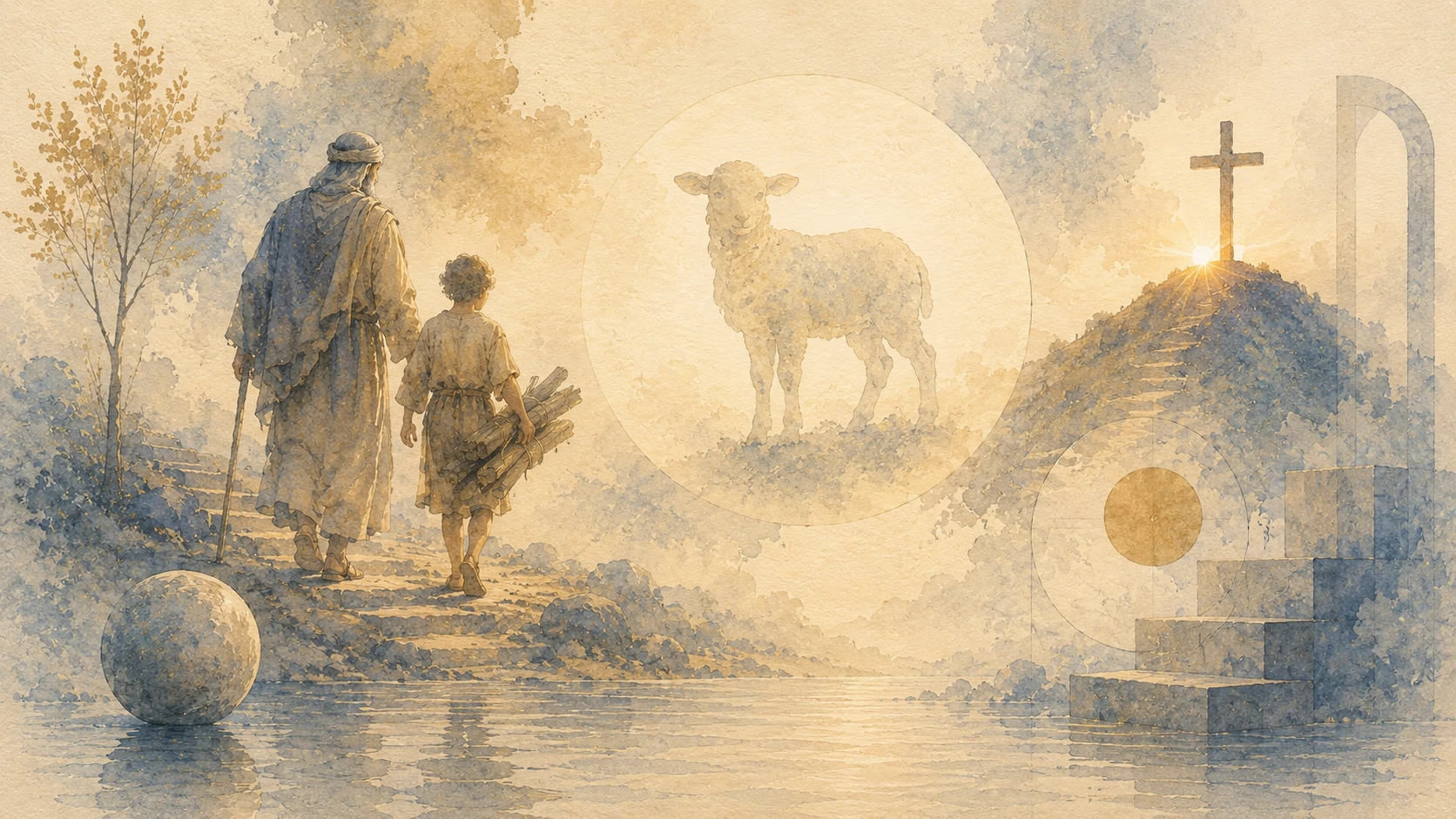
“And Abraham said, My son, God will provide himself a lamb for a burnt offering: so they went both of them together.”
Mount Moriah is one of the most mysterious mountains in Scripture.
A father walks upward carrying the weight of obedience. A son walks beside him carrying the wood for sacrifice. And hanging over the entire journey is a question Isaac cannot fully understand:
“Where is the lamb?”
Abraham’s response becomes one of the most prophetic statements in the entire Old Testament:
“God will provide himself a lamb.”
At the surface, Abraham speaks with faith that God will somehow intervene. But beneath the immediate moment lies something far greater.
The statement reaches forward through centuries.
It points toward Christ.
The story of Abraham and Isaac is not simply about sacrifice. It is about divine provision. Humanity spends much of history attempting to bridge the gap between itself and God through offerings, rituals, obedience, and sacrifice. Yet Genesis 22 introduces a profound reversal: God Himself becomes the provider of the sacrifice. This transforms the entire meaning of redemption. The burden of salvation does not ultimately rest upon man ascending toward God. It rests upon God descending toward man.
When John the Baptist sees Jesus approaching in John 1:29, he declares:
“Behold the Lamb of God.”
This is not random language. John is intentionally invoking the imagery of Genesis 22.
The lamb Abraham spoke of was never merely the ram caught in the thicket. That animal was only a temporary shadow.
Christ becomes the true fulfillment of Abraham’s words.
On Mount Moriah, Isaac carried the wood. At Calvary, Christ carried the cross.
A father prepared to surrender his beloved son. The Father surrendered His beloved Son.
The parallels are impossible to ignore.
There is also a psychological dimension to the story.
Isaac walks beside Abraham in trust, unable to fully see what lies ahead. Human beings often walk through life the same way.
We do not always understand suffering. We do not always understand delay, fear, sacrifice, or uncertainty.
Yet the story suggests something profound: even when human understanding fails, divine provision remains ahead of us.
The mountain of fear becomes the mountain where God reveals Himself.
Abraham’s statement is ultimately about more than Isaac. It is about the entire human condition. Humanity could not save itself. No sacrifice originating from man could fully heal the fracture between God and humanity. So God provided the Lamb Himself. And this is why John’s declaration carries such weight: “Behold the Lamb of God, which taketh away the sin of the world.” The story that began in Genesis finds its fulfillment in Christ.
The journey up Mount Moriah becomes a shadow of the Gospel itself.
A son carrying wood. A father willing to surrender. A promised lamb. A divine substitute.
And through it all, one truth echoes across Scripture:
God will provide.
The app behind these insights
About Illumen Scripture
Illumen Scripture is a Bible reading and study app built to help you engage Scripture with clarity, context, and reflection. Read with maps and timelines, take notes, explore AI-assisted study tools, and follow Illumen Insights—articles like this one—in a single, focused reading experience on web and iOS.
Be the first to know when
we publish new insights.
No spam, unsubscribe anytime.